
Introduction
Learning Through Childhood’s Natural Context
When we think of therapy, it is difficult not to picture something educational or medical in nature: flashcards, instructions, questions, and responses (a child with identified needs encountering an adult with specialist knowledge, followed by some form of formal teaching).
Across education and human services, broader movements towards self-direction, autonomy, and person-centred support have also influenced how we think about early intervention. Play-based approaches are not a movement away from learning or therapy. They are the deliberate integration of teaching and therapeutic processes into the childhood experience of play. A play-based approach recognises that children approach the world with energy, curiosity, and a desire to explore, and places purposeful intervention within those motivations rather than outside them.
Understanding Play
What Do We Mean by Play?
“Play is, first and foremost, an expression of freedom.”
Peter Gray
Play is fun. It is self-directed and self-motivating. It is what children do when nobody is telling them what to do. It is driven by curiosity, imagination, and the desire to explore.
Play is where children learn how things move and how their bodies move. It is where they learn to communicate, cooperate, negotiate, and take their place alongside other people. It is where they test ideas, solve problems, practise emerging skills, and discover what they can make happen.
Through play, children rehearse the world around them. They cook meals, care for babies, visit doctors, put out fires, build homes, and create families and communities. They apply what they know, explore what they do not yet understand, and practise the skills of everyday life within the relative safety of an imagined world.
Play is the creative force through which children prepare themselves for life. It gives shape to their curiosity, expands their imagination, and allows them to explore relationships, knowledge, movement, language, and possibility. It is the essence of life distilled into the world of children.
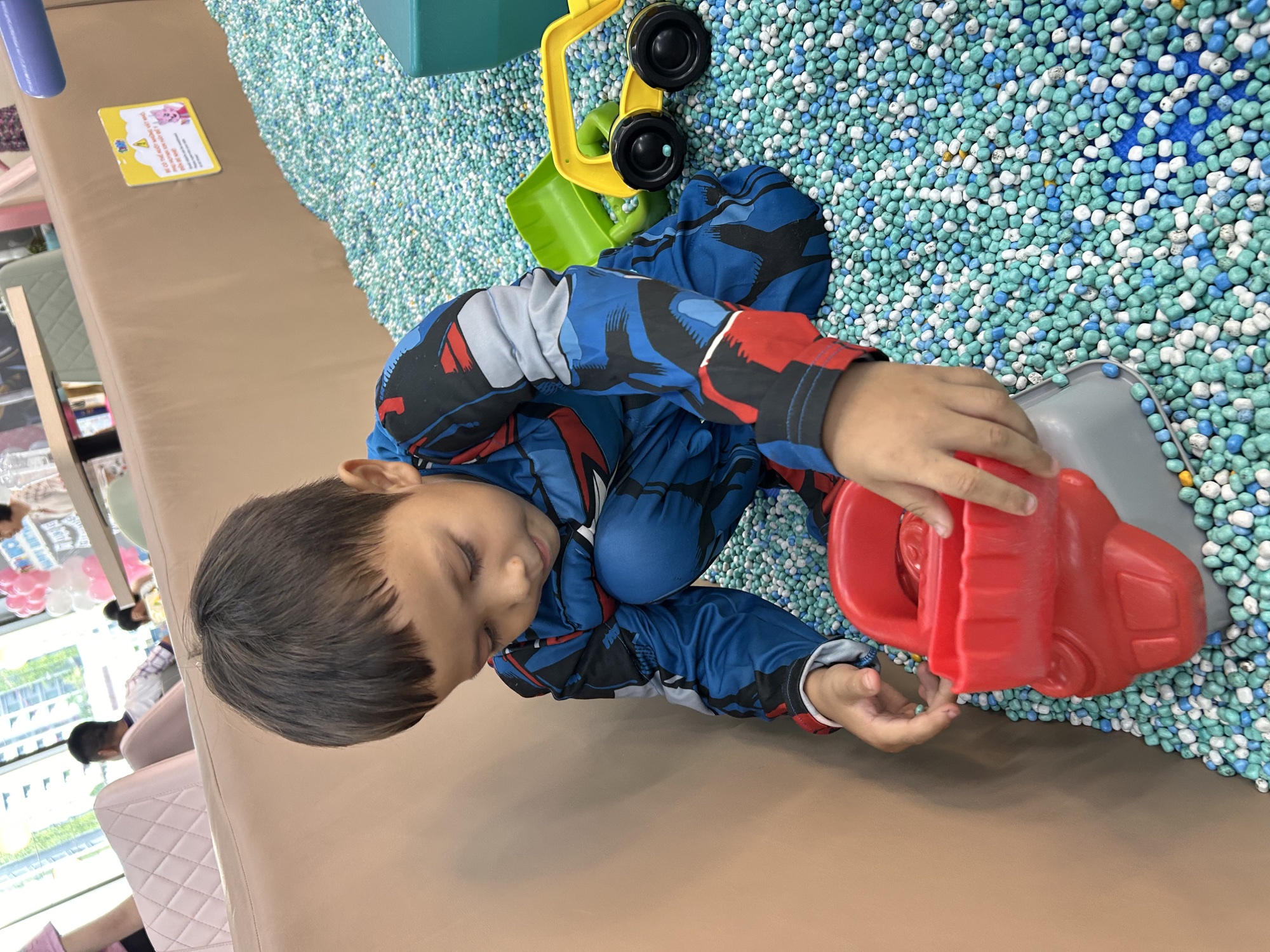
Play can be sensory in nature: things children feel, look at, light up, spin, or simply enjoy experiencing. It can involve construction, such as building with Lego, blocks, or other materials. It often involves imagination. Children play with toy cars and pretend there has been an accident, race fire engines to a rescue, create families with dolls and dollhouses, or dress up and enter imagined worlds. Play can also be creative, involving music, painting, drawing, and making things.
Whatever form it takes, the central point is that play is self-directed and enjoyed for its own sake. The child takes part because the experience is interesting, enjoyable, or satisfying, rather than because an adult has asked for a particular response or expects a finished product. Even when play is shared with other people, the activity remains guided by the children’s interests, ideas, and enjoyment.
Purposeful Learning
Using Play as a Context for Intervention
Play-based intervention begins with the qualities that children already bring to play: energy, curiosity, initiative, and a desire to discover how the world works. Rather than putting those qualities aside so that teaching can begin, we use them to create opportunities for children to acquire skills that matter in their everyday lives.
At its best, play-based intervention brings together two things that are too often separated: the child’s natural drive to explore and our responsibility to support their development. The learning remains intentional, but it is connected to experiences that the child finds meaningful. The aim is to build skills that are inherently linked to their interests, their curiosity, and their thirst for knowledge.
Three advantages
Why Use a Play-Based Approach?
Motivation
When a child is absorbed in play, we do not have to manufacture a reason for them to take part. Their interest is already carrying the activity forward. This gives us opportunities to introduce learning while preserving the child’s willingness to engage, persist, and return.
Relevance
Skills are taught through play activities that the child meaningfully engages with throughout their daily routines. Within those experiences, children learn to communicate what they want or need, follow useful instructions, strengthen specific motor skills, and practise the activities of everyday life. They simulate situations, build their knowledge of the world, solve problems, imitate others, and create new ideas that deepen their enjoyment of what they are doing. The learning has an immediate purpose because it helps the child participate more fully in experiences that already matter to them.
Generalisation
The purpose of therapy is not to teach a child to respond while the therapist is present. It is to build skills the child can use after the session has ended, within their relationships and as part of their daily routines. Children continue to play when we are gone. When communication, imitation, problem-solving, motor, and social skills are learned through play, children can keep using, practising, and strengthening these abilities each time that they play. When those skills make play more successful, enjoyable, and interesting, the play itself gives the child a reason to continue using them. This is the real strength of play-based intervention: learning continues long after the therapist has left.
A Worked Example
What Does Play-Based Intervention Look Like?
Let’s imagine a child who loves Lego. They are playing with their therapist when suddenly the child has an idea.
“Lego,” the child says to the therapist.
“That’s a great idea,” says the therapist. “Why don’t you go and get your Lego?”
The therapist points towards the box on the shelf. The child follows the instruction, gets the Lego, and brings it over.
“What should we build?” the therapist asks.
“House,” says the child.
“I love that idea. Let’s do it together. How many blocks do you need?”
The child holds up five fingers.
Together, they count the pieces: one, two, three, four, five. The therapist begins building one of the walls and invites the child to copy. The child imitates the design but finds some of the pieces difficult to connect. The therapist offers enough support to help them succeed while leaving the child actively involved in completing the wall.
“What colour do you need now?”
“Green.”
The therapist passes over another green block. As the activity continues, the child repeatedly practises asking for what they want and need. Communication gives them access to the materials and allows them to influence what happens next.
“Window,” the child says spontaneously.
“Great idea.”
The therapist finds two window pieces and gives them to the child. “Why don’t you put them here and here, so Mummy and Daddy can see outside?”
The child follows the instruction and adds the windows.
As the child continues building, the therapist briefly records what is happening in a nearby data sheet. They note the child’s independent requests, the range of vocabulary used, the ability to request pieces by colour, and the successful completion of instructions supported by gestures. Each of these relates to a target within the child’s intervention programme.
To someone unfamiliar with play-based intervention, this may simply look like a child and an adult enjoying Lego together. Beneath the surface, however, the therapist is carefully delivering an individualised programme within an activity shaped around the child’s interests. Communication, imitation, following instructions, counting, colour recognition, fine-motor coordination, and problem-solving are all being practised without separating the child from the play. This is an activity that has been planned for by the therapist as a strong option for learning during the session, but ultimately selected by the child because they are genuinely motivated to engage.
The same process can take many different forms. A child might ask a therapist to throw a ball, follow an instruction to kick it, or practise taking turns while both people are having fun. At times, the therapist may introduce a brief, more concentrated burst of teaching (perhaps quickly rehearsing useful labels or extending a few conversational exchanges) before allowing the play to move forward again. The balance depends on the child’s developmental level, engagement, and tolerance for adult involvement.
Play-based intervention has no single appearance. What we should expect to see is a child enjoying the activity, learning something meaningful, and participating with relatively little resistance. Learning may still require effort, but it does not have to feel like something imposed from outside. It is woven naturally into something the child already wants to do.
Building the Foundation
Creating the Context
Knowing what play looks like is only the beginning. We cannot simply enter an activity, introduce intervention targets, and expect the child to remain engaged. Before purposeful teaching can be woven into play, we need to discover what the child genuinely enjoys, learn how to join them successfully, and build a strong foundation of shared engagement. This takes time and can sometimes be difficult to achieve. The process must unfold gradually, allowing the child to become comfortable with our involvement before we begin introducing greater direction, expectations, and opportunities for learning.
Discovering and Expanding What the Child Enjoys
Before we teach anything, we need to discover what makes this particular child want to play. If play is going to carry the intervention, it must begin with experiences the child finds genuinely motivating.
There are several ways to build this understanding. We can speak with parents, teachers, and anyone else who knows the child well. We can ask what captures the child’s attention, what they repeatedly return to, what makes them laugh, and what they seek out when nobody is directing them.
We can also observe the child in an environment filled with different opportunities for play. This is often an active and carefully planned process. During the early sessions of any intervention programme, the practitioner is not primarily there to teach or implement targets. They are there to explore: introducing possibilities, observing the child’s response, and gradually building a picture of what the child enjoys.
For some children, this may be relatively straightforward. We introduce several activities, offer some gentle encouragement, and quickly discover what draws them in. Other children may show little interest in conventional toys or may return almost exclusively to one or two highly preferred activities. At that point, the practitioner has to become especially purposeful and creative.
This may involve working with colleagues to plan many possible ways of using even the simplest object. A ball can be thrown, pushed, bounced, rolled, or used in a tickling game. It can become a sun, an apple that someone pretends to bite, or a face waiting to be drawn. A block can be stacked, hidden, knocked down, pushed like a vehicle, or transformed into part of an imagined world. The purpose is not to make the child use the object correctly. It is to discover which possibilities invite interest, enjoyment, and further exploration.
We may need to repeat this process with many objects, in many different ways, and across many days. Exploration can be difficult. When a child appears uninterested, it is easy to retreat into structured teaching simply because structure gives the adult something clear to do. However, discovering motivation is not a preliminary inconvenience. It is the foundation on which play-based intervention is built.
Nor does this process ever truly end. Even after working with a child for a long time, we continue searching for new interests, new variations, and new sources of enjoyment. We also expand what the child already loves, helping their play become broader, richer, and more flexible over time. For children with developmental delays or limited play repertoires, this may itself be one of the most important parts of the intervention.
Learning How to Play Together
Before we begin weaving intervention targets into the child’s favourite activities, we need to know that we can actually maintain meaningful play-based interaction with the child for an extended period of time.
This means more than sitting nearby while the child plays. The practitioner needs to become someone whose presence adds to the experience: someone the child notices, welcomes, and increasingly includes. We begin by observing, joining at the child’s pace, and responding to what they are already doing. We might imitate an action, build alongside them, add a simple narrative, or offer a small variation and see whether the child takes it up.
At this stage, we are not asking questions, testing knowledge, or placing demands. We are learning how to sustain an enjoyable interaction without taking control of it. If the child moves away, loses interest, or begins resisting our involvement, we have probably added too much or moved too quickly. We step back, rebuild the enjoyment, and try again.
The initial goal might be five minutes of genuinely shared play. Over time, this may grow to ten, fifteen, or twenty minutes in which the child remains engaged and the practitioner is actively part of the experience. These times are not rigid criteria. They simply illustrate that shared play is something we build gradually rather than assume is already available.
This can sound easy, but it is not. Adults are accustomed to instructing, questioning, and directing children. It can feel uncomfortable to spend time playing without immediately producing a measurable response. We might be self-conscious about pretending that we absolutely love a fire truck, an aeroplane, or dinner time with dolls and stuffed animals. Yet the practitioner must learn to relax into the activity, remain curious and enthusiastic, and genuinely enjoy the experience with the child.
Only once this foundation has been established should we even consider weaving targets into the play. The stronger the shared enjoyment and engagement, the more the play can carry without losing the qualities that made it motivating in the first place.
Putting It into Practice
How Do We Make It Happen?
Once the foundations are in place (and only when they are firmly in place) it is time to move forward. We can begin selecting meaningful targets, weaving them gradually into the play, and sharing what we are doing with the people around the child so that learning can continue beyond the therapy session.
Identifying Meaningful Targets
Any intervention programme for any child should be built on a thorough understanding of that child’s needs. This requires in-depth assessment before specific intervention targets are selected.
The early process of exploring a child’s interests often forms part of this assessment. Through conversations with the people who know the child well, direct observation, and structured testing of skills and interests, practitioners begin to understand both the child’s developmental profile and the activities that motivate them to engage with the world around them.
The recommendations produced by any assessment are usually broad. An assessment might identify that a child needs to communicate more effectively when asking for something that they want or need. It may highlight difficulties with following instructions, imitating actions, developing motor skills, or expanding on a limited range of interests. What it does not necessarily specify is the exact word, action, or play experience that should be taught during a particular week.
This is where intervention planning becomes more contextualised. The therapist takes the broader developmental recommendations and connects them to the specific activities being incorporated into the child’s play-based programme.
If the child is learning to ask for what they want or need, the first targets might involve requesting favourite toys, play actions, or sensory experiences. The child might learn to ask for help when pieces of a Lego structure are difficult to connect. If imitation is a priority, the therapist can look for opportunities within movement games, songs, construction, or object play. Target selection is guided by the results of an assessment, but the forms they take are shaped by the child’s interests.
Not every intervention target will fit naturally into every play activity. The aim is not to force all learning into play regardless of whether it belongs there. The aim is to create as much alignment as possible between what the child needs to learn and what they are motivated to do.
This matching process is an essential part of weekly programme planning. In a well-designed intervention, practitioners continually connect developmental priorities with the interests the child is expressing, creating teaching opportunities that are both purposeful and meaningful.
Weaving Targets into Play
Once the foundations are in place, we can begin weaving intervention targets into the play. This should feel like a natural progression because the targets have already been connected to activities and interests that the child enjoys and that the practitioner now understands well.
The key is to begin gradually and take a developmental approach. We start with what the child can already do. Most of what is expected during the play should initially consist of familiar skills that the child can perform confidently. This allows the interaction to remain successful while strengthening engagement, rapport, and the child’s willingness to respond.
New learning is then introduced within that success. The practitioner might gently prompt the child to use a word to request something they want, support them to follow a new instruction, or model an unfamiliar action for them to imitate. The adult remains positive and playful, introducing small amounts of challenge without allowing those challenges to interrupt the activity or take over the experience.
The level of expectation can increase gradually. This might happen over the course of one session, across several sessions, or over many weeks or months. Children develop at different rates, and they also differ in how quickly they become comfortable with another person contributing ideas, giving directions, or asking more of them during play.
Introducing direction is not inherently a problem. The practitioner will sometimes lead, place demands, and expect a response. What matters is the balance. These moments of adult direction must remain surrounded by generous amounts of genuine, child-directed play, enjoyment, and reinforcement. The practitioner invests heavily in becoming associated with what the child likes before gradually asking the child to do more.
Over minutes, hours, days, weeks, months, and years, the amount of direction and shared engagement that the play can support may grow considerably. If we build slowly, the play becomes able to carry increasingly complex learning. If we move too quickly, overload the activity with demands, or repeatedly interrupt the child’s enjoyment, the engagement on which the intervention depends can quickly fall apart.
Teaching the Family to Play
It is one thing to teach a child to play. It is another thing to make sure that the people around the child know how to join them.
One of the strengths of play-based intervention is its potential to continue beyond the therapy session. Children have access to play throughout their daily lives and will continue seeking out activities that interest them. However, we cannot assume that the adults around them are regularly participating in that play or feel confident about how to do so.
Families come from different cultural backgrounds and bring different experiences, expectations, skills, and levels of enthusiasm for playing with children. Some adults enter into play easily. Others may feel awkward, uncertain, or unaware of how much can be achieved through a playful interaction. This should never be treated as a failure on the part of the family. It is simply another area we may need to understand and support.
Practitioners should consider the family’s current ability, willingness, understanding, and confidence with play. Once a play-based approach is established, family members should be intentionally included in the process. The exact arrangements will depend on the service and the family’s circumstances, but an open-door approach is valuable. This does not mean that family members enter sessions whenever and however they choose. Their involvement should be planned carefully and built into the intervention.
Observation is often the best place to begin. Families need time to understand the culture of the intervention and see what play-based teaching looks like in practice. Lengthy explanations are rarely the most convincing introduction. Let them see the child become enthusiastic, animated, and engaged. Let them notice the communication, interaction, and learning emerging within the play.
As family members become more comfortable, they can be invited to step in and have a turn. They should begin with the same foundation as the practitioner: learning how to join the child, sustain an enjoyable interaction, and become someone whose participation adds to the experience.
The purpose is not to train family members to become therapists. It is to transfer practical skills that help the child use and maintain what they have learned outside therapy sessions. This might involve showing a family member how to create natural opportunities for the child to ask for something they want, follow a simple instruction, or request help. It might involve modelling how imitation can be used to introduce and cultivate new forms of play. The practitioner demonstrates these strategies, gives the family member time to practise them, and offers gentle, encouraging feedback as their confidence develops.
The process mirrors the one followed with the child: observe, model, practise, support, and build slowly. We are not only teaching the child to play. We are helping the whole family develop a culture in which play, connection, and learning can continue long after the therapy session has ended. How much support is needed, and what that support looks like, will vary from one family and context to another.
Further Reading
Evidence and References
This guide applies to play-based interventions across a broad range of developmental, communication, behavioral, and learning needs. Several established intervention models developed for young autistic children provide important examples of approaches in which motivation, child interests, natural reinforcement, shared engagement, and play are deeply integrated into purposeful intervention.
- Gray, P. (2013). Definitions of Play. Scholarpedia, 8(7), 30578.
- Skene, K. and colleagues (2022). Can Guidance During Play Enhance Children’s Learning and Development in Educational Contexts? A Systematic Review and Meta-analysis. Child Development, 93, 1162–1180.
- Schreibman, L. and colleagues (2015). Naturalistic Developmental Behavioral Interventions: Empirically Validated Treatments for Autism Spectrum Disorder. Journal of Autism and Developmental Disorders, 45, 2411–2428.
- Dawson, G. and colleagues (2010). Randomized, Controlled Trial of an Intervention for Toddlers With Autism: The Early Start Denver Model. Pediatrics, 125, e17–e23.
- Pivotal Response Training. What Works Clearinghouse, Institute of Education Sciences.
- Crank, J. and colleagues (2021). Understanding the Effects of Naturalistic Developmental Behavioral Interventions: A Project AIM Meta-analysis. Autism Research, 14, 817–834.
- van Noorden, L., Gardiner, S., and Waddington, H. (2024). Parent-Mediated Naturalistic Developmental Behavioral Interventions for Young Autistic Children: A Systematic Literature Review of Single-Case Research.